
Types of Vendor Contracts: The 10 Agreements Every Business Signs (And What Each One Actually Does)

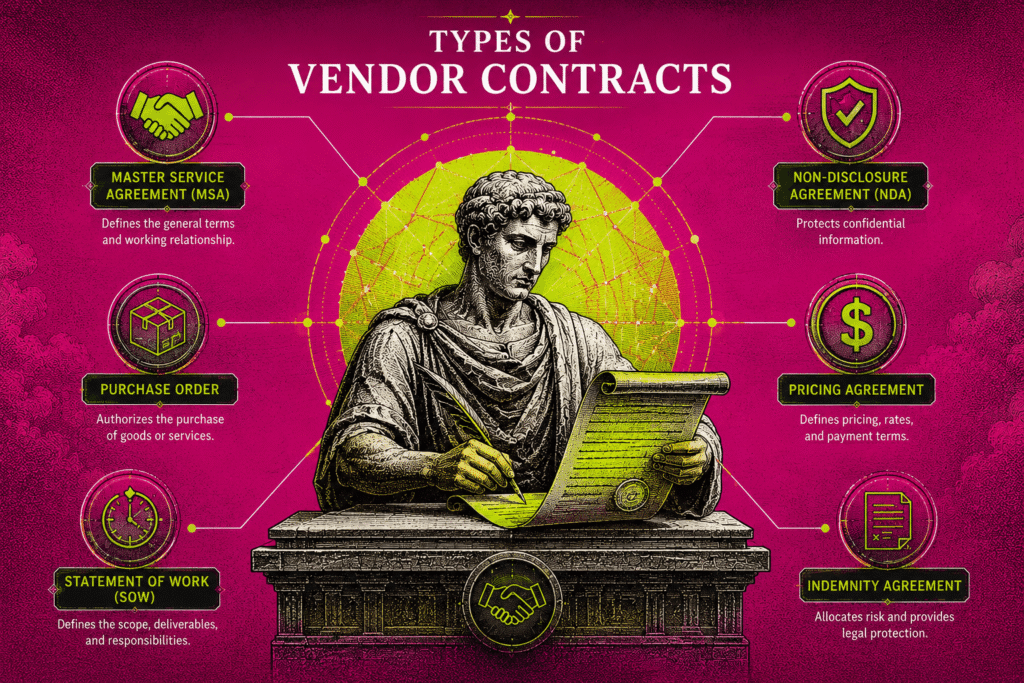
KEY TAKEAWAYS
- Vendor relationships are governed by a stack of contract types — each serving a different purpose — and most organizations use 6-10 of these agreement types regularly, often without understanding how they interact.
- The master service agreement (MSA) plus statement of work (SOW) model is the most common enterprise vendor contracting structure — the MSA sets the relationship terms, the SOW defines each specific project.
- Non-disclosure agreements (NDAs), service level agreements (SLAs), and independent contractor agreements are the three most frequently misunderstood contract types — drafted with boilerplate language when specificity would prevent real problems.
- Fixed-price, cost-plus, and time-and-materials contracts each shift risk differently between buyer and vendor — the choice is a risk allocation decision, not just a pricing decision.
- Every vendor relationship should start with the question: what contract type fits this engagement? Getting the structure wrong at the start creates problems that clause negotiation cannot fix.
The 10 vendor contract types that cover 90% of business relationships
1. Non-Disclosure Agreement (NDA)
The entry point for most vendor relationships. Signed before any confidential information is shared — during vendor evaluation, sales conversations, partnership discussions, or due diligence.
What it governs: What constitutes confidential information, how it can and cannot be used, how long the obligation lasts, and what happens if confidentiality is breached.
Key decision: mutual or one-way? A mutual NDA protects both parties’ confidential information. A one-way NDA protects only one party’s information. Most vendor evaluation NDAs should be mutual — you are sharing requirements and business context; the vendor is sharing product details and pricing. [NDA template download]
Common mistake: Using an overly broad definition of “confidential information” that includes everything either party ever says. Broad definitions create enforcement problems — courts are skeptical of NDAs that claim everything is confidential. A specific definition protects better than a sweeping one.
2. Master Service Agreement (MSA)
The umbrella agreement that establishes the terms governing an ongoing vendor relationship. The MSA handles the legal framework — liability, indemnification, IP ownership, payment terms, termination rights, and dispute resolution — so that individual projects can be scoped through simpler Statements of Work.
What it governs: The rules of the relationship, not the specifics of any single engagement.
Key advantage: The MSA/SOW model eliminates the need to renegotiate legal terms for every new project with the same vendor. Once the MSA is signed, new projects launch with a SOW that references the MSA’s governing terms. [MSA template download]
Common mistake: Negotiating an MSA and then never actually referencing it in the SOW. A SOW that does not explicitly incorporate the MSA creates ambiguity about which terms apply.
3. Statement of Work (SOW)
The project-specific document that defines scope, deliverables, timelines, milestones, acceptance criteria, and pricing for a specific engagement under an MSA.
What it governs: The what, when, and how much of a specific project.
Key provisions: Acceptance criteria are the most important and most frequently omitted. Without defined acceptance criteria, “deliverable X” is complete whenever the vendor says it is. With acceptance criteria, completion is measurable and disputes are resolvable. [SOW template download]
Common mistake: Scope creep without change orders. Scope evolves in every project. A SOW without a change-order process treats scope changes as informal adjustments — creating misaligned expectations and budget overruns.
4. Service Level Agreement (SLA)
Defines measurable performance standards for a vendor relationship — uptime, response time, resolution time, delivery schedules — and the consequences of missing them.
What it governs: How well the vendor must perform, and what happens when they don’t.
Key distinction: An SLA can be a standalone agreement or a section within an MSA or SOW. Regardless of format, the operative question is the same: are the consequences of non-performance meaningful enough to be enforceable? Service credits of 1-2% of monthly fees for an SLA breach are mathematically insignificant. Graduated penalties — credits for minor breaches, early termination triggers for sustained breaches — create actual accountability. [SLA template download]
Common mistake: Measuring the wrong things. An SLA that measures uptime but not performance (response time, throughput, accuracy) lets a vendor technically meet the SLA while delivering a degraded experience.
5. Independent Contractor Agreement
Governs the relationship with individual contractors — establishing that the contractor is not an employee, defining the scope of work, payment terms, IP ownership, and confidentiality obligations.
What it governs: The working relationship, tax obligations, IP rights, and the legal distinction between contractor and employee.
Critical provision: Worker classification. The IRS (in the US) and equivalent agencies globally scrutinize independent contractor classifications. A contractor who works exclusively for one company, follows the company’s schedule, and uses the company’s equipment may be reclassified as an employee — triggering back taxes, benefits, and penalties. The contract must reflect the actual working relationship, not just the desired classification.
Common mistake: Using a one-page contractor agreement that lacks IP assignment provisions. If the contractor creates work product — code, designs, content, strategies — and the contract does not explicitly assign IP to the company, the contractor may retain ownership.
6. Subcontractor Agreement
When a primary contractor engages another company or individual to perform part of the work, the subcontractor agreement governs that secondary relationship.
What it governs: Scope, payment (typically as a subset of the primary contract value), quality standards, and flow-down provisions that pass the primary contract’s requirements to the subcontractor.
Key provision: Flow-down clauses ensure that confidentiality, IP, compliance, and quality requirements from the primary contract apply equally to the subcontractor. Without flow-down, the primary contractor can hire subcontractors who are not bound by the standards the buyer negotiated.
7. Purchase Order
A transactional document for specific purchases — quantities, unit prices, delivery dates, and quality specifications. Purchase orders often reference an underlying MSA or vendor agreement for governing terms.
What it governs: A specific purchase transaction — what, how much, when, and at what price.
Key distinction from contracts: A purchase order is typically a buyer-issued document. When the vendor fulfills the order, a contract is formed. The terms governing that contract depend on whether an MSA exists, whether the PO references governing terms, and whether the vendor’s acceptance adds conflicting terms (the “battle of the forms”).
8. Fixed-Price Contract
A contract where the vendor agrees to deliver a defined scope for a fixed total price, regardless of actual costs incurred.
Risk allocation: The vendor bears the risk of cost overruns. If the project takes longer or costs more than estimated, the vendor absorbs the difference. The buyer bears the risk of scope limitation — if the scope is defined too narrowly, additional work requires a change order at additional cost.
Best for: Projects with clearly defined scope, established technology, and predictable effort. Custom software development, office build-outs, and equipment installations with detailed specifications.
Worst for: Exploratory projects, R&D engagements, or any scope where requirements will evolve significantly during execution.
9. Cost-Plus Contract
A contract where the buyer pays the vendor’s actual costs plus a markup (either a fixed fee or a percentage of costs).
Risk allocation: The buyer bears the cost risk — actual costs are passed through, and the vendor has limited incentive to control expenses. The vendor bears minimal financial risk beyond their ability to perform.
Best for: Projects where scope is uncertain, where cost estimation is unreliable, or where the buyer needs maximum flexibility to adjust direction during execution. Government contracting uses cost-plus structures extensively.
Worst for: Any engagement where cost control is a priority. Without contractual cost ceilings, cost-plus contracts can overrun significantly.
10. Time and Materials (T&M) Contract
A contract where the buyer pays based on the vendor’s hourly rates multiplied by actual hours worked, plus material costs.
Risk allocation: Shared risk. The buyer controls scope (and can adjust at any time). The vendor bills for actual effort. A not-to-exceed cap limits the buyer’s maximum exposure while maintaining flexibility.
Best for: Consulting engagements, staff augmentation, ongoing support services, and projects where scope is expected to evolve. The T&M structure with a monthly or quarterly not-to-exceed cap is the most flexible and most commonly used structure for professional services.
Worst for: Projects where the buyer needs budget certainty. T&M without caps creates open-ended financial commitments.
How contract types interact
Vendor relationships often involve multiple contract types working together:
An NDA is signed during vendor evaluation. If the vendor is selected, an MSA establishes the relationship framework. Each project is governed by a SOW that references the MSA. The SOW includes or references an SLA defining performance standards. If the vendor brings in specialists, a subcontractor agreement with flow-down provisions applies.
Understanding this stack — and knowing which agreement governs which aspect of the relationship — prevents the confusion that arises when parties disagree and nobody is sure which document controls.
Frequently Asked Questions
What are the main types of vendor contracts?
The 10 primary types are: NDA, Master Service Agreement, Statement of Work, Service Level Agreement, independent contractor agreement, subcontractor agreement, purchase order, fixed-price contract, cost-plus contract, and time-and-materials contract. Most vendor relationships use a combination of these.
What is the difference between an MSA and a SOW?
An MSA establishes the legal framework for a vendor relationship (liability, IP, termination rights). A SOW defines the specifics of a single project (scope, deliverables, timeline, price). The SOW operates under the MSA’s governing terms.
When should I use a fixed-price vs. time-and-materials contract?
Use fixed-price when scope is well-defined and unlikely to change. Use time-and-materials when scope is expected to evolve, when flexibility is more important than budget certainty, or when the engagement is exploratory. Add a not-to-exceed cap to T&M contracts to limit financial exposure.
What is a blanket purchase order?
A blanket purchase order (BPO) is a standing order that authorizes a vendor to supply goods or services over a defined period at pre-negotiated prices, without requiring individual purchase orders for each transaction. BPOs are common for recurring supply relationships.
Do I need a separate SLA, or can it be part of the contract?
An SLA can be a standalone agreement, a schedule attached to an MSA, or a section within a SOW. The format does not matter — what matters is that performance standards and consequences for non-performance are clearly defined, measurable, and enforceable.
Choosing the right structure is the first decision, not an afterthought
Contract type determines risk allocation. Risk allocation determines who pays when things go wrong. Getting the structure right at the start prevents problems that no amount of clause negotiation can fix later.
Before drafting a single clause, ask: what kind of relationship is this? What kind of risk does it carry? What kind of flexibility does it need? The answer determines the contract type. The contract type determines the template. The template determines the starting position for negotiation. Every step downstream depends on getting this first step right.
Author bio: Written by the editorial team at thevendor.ai. No vendor sponsorship. No affiliate links.
Published by thevendor.ai· The Neutral Authority in Vendor Contract Management
No vendor sponsorship. No affiliate links. Independent research.